Added 4-4-26
Back in my days of international travelling, near the top of my rucksack rode a smaller daysack.
For most trips, this was a well‑made two‑compartment North Face pack, sadly no longer with me.
This daypack was always packed and ready to go. At most, I might have to transfer the water bottle, rain gear and guidebook from the larger pack if I had needed them while in transit.
When I hit a town, I would leave the large pack at a hostel, grab the daypack and be off to see what sights there were to see.
A similar approach will help in managing the soldier’s load.
Rations, dry clothing, sleeping gear and other essentials are bulky and require a large backpack to contain them.
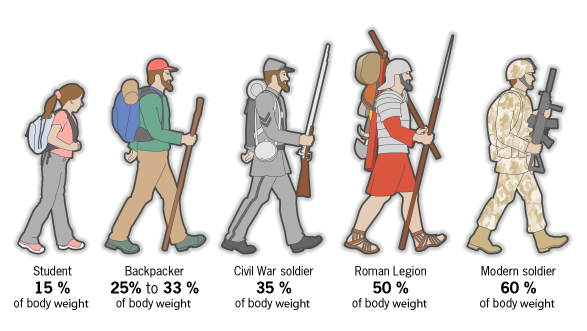
Fighting with such a large bulk on your back is not practical, although this does not stop certain armies from trying.
When the bullets fly, drop your pack!
A related idea is for the soldier to carry enough gear on their belt and webbing to survive 24 hours without their pack.
The kit recommended may carry such unnecessary items as a shaving kit, boot polish, stove, bulky sewing and repair “housewife” and so on.

A belt kit may weigh as much as 35 lbs. This weight is constantly with the soldier, fatiguing them.
Soldiers look like the Michelin man or a fat Batman, and are constantly burdened with the mass and bulk of items they can survive without.
Ironically, excessive belt kits often hinder the ability to carry a large pack.
On the modern battlefield, the survival of a soldier or marine will often depend on their ability to utilize microterrain.
To avoid enemy fire or observation, a soldier may need to crawl or move close to the ground.
They may also need to move swiftly across open areas or other obstacles.
Unnecessary mass or bulk that may hinder the fighter crawling or sprinting may get them killed.
A couple of hours without tea, or skipping one meal is unlikely to kill you. Being so weighed down and bulky that you cannot move quickly or crawl when needed, might!
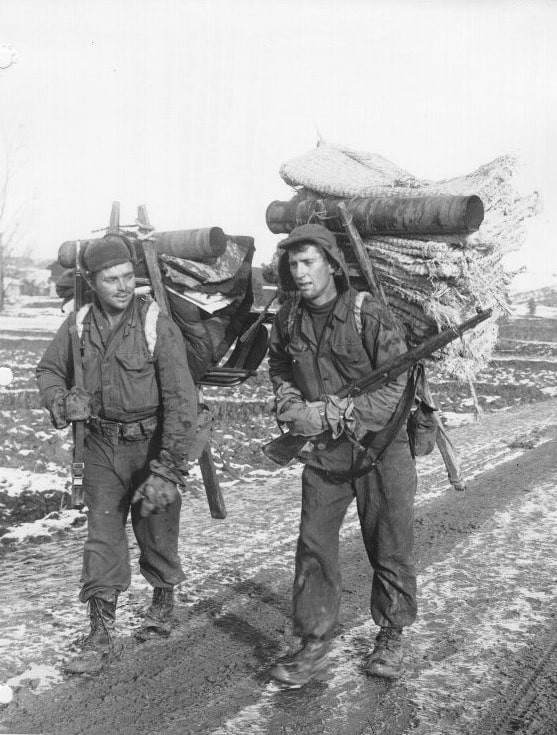
Excessive and unnecessary load decreases soldier effectiveness and increases the change of becoming a casualty.
A better approach is for the webbing (LBE) to concentrate on combat‑relevant items: ammunition, water, trauma‑orientated medical items, CBRN/NBC and certain tools.
“Survival kit” items belong in the trouser pockets and trouser belt. You may have to ditch your webbing, and that is when you will start needing your survival kit.
This leaves a “middle ground” of other items that may be needed on a combat operation or when away from the large packs, but do not belong or cannot be carried on the webbing.
Modern operations often require equipment that will not fit on the webbing. Sensors, communication gear, demolitions equipment, drones and their controls, ammunition for crew‑served weapons, shoulder‑launched munitions, claymore mines and many other items.
Ammunition for crew‑served weapons, for example, should be capable of easily being transferred to the weapon crew.
The best solution seems to be the use of a “mission bag”/mission pack/small pack, which can carry more gear, but can be readily discarded when the tactical situation calls for a lighter load and faster movement.
A well‑designed mission pack will carry the weight on the hips and pelvis without the need for a heavy belt kit that is difficult to remove.
While some soldiers are already using this idea, it has yet to be systemized for optimal efficiency.
Firstly, the mission pack should have adequate capacity to contain the recommended items, with sufficient organization that items may be readily located when needed.
Secondly, it must be of a shape, size and configuration that it easily fits in the top of a larger rucksack, and may be removed in a hurry.
This suggests a pack capacity of 30 litres or less.
There are large pack designs where a smaller pack attaches to the outside. If used for mission specific gear, this would tend to unfavourably shift the wearer’s centre of balance.
When worn, the mission pack/small pack should not be so large nor so heavy that it hinders a soldier’s movements in combat, or makes them a significantly larger target when prone.
The top edge should not be so high that it prevents the soldier correctly positioning their head for firing when prone.
If extra gear such as LAW/LASW rockets are strapped to the outside, it should not be wider than the soldier’s body.
Since soldiers are often prone, and may be viewed from above by drones and aircraft, the “public” side of the mission pack/small pack should have 3D camouflage measures applied. Strips of cloth (“textilage”) and local foliage should be added to the PALS straps. A “brown‑dominant” camouflage pattern should be used for the mission pack since it is likely to be used when in arid conditions, urban environments or on forest floors of dead leaves.
Like the rifle, the mission pack is always within easy reach if not being worn nor carried. When sleeping, it serves as a pillow.
Many of the items suggested below are the permanent contents of the mission pack.
Other items, such as the rain gear or entrenching tool, may migrate between the webbing, mission pack/small pack and large pack as needed.
• Mission Specific Items: The mission specific items are likely to be the heaviest and densest component of the load.
Mission specific gear will include batteries, air to ground marker panels, signalling pyrotechnics, lightsticks, night vision gear.
Ammunition will include spare ammunition for personal weapons, and ammunition for crew‑served weapons.
Ammunition for crew‑served weapons should be carried in a configuration which may easily be transferred to the weapon crew.
For specialists such as medics, signallers and sappers, mission specific load would include medical kits, radios, electronic items or demolition equipment.
The mission specific contents need to be carefully considered and strictly policed.
The US 4th Infantry Division at Pleiku, Vietnam concluded in 1967 that no more than 300 rounds per man was needed: “Units should reduce weight loads of individual soldiers by maintaining no more than 300 rounds of ammunition per man. Experience has proven that more than 300 rounds per man is excessive weight and reduces his efficiency in movement over rough terrain.”
From “U.S. Army Uniforms of the Vietnam War” by Shelby Stanton, p.13
I do not have access to the original source, so do not know if “300 rounds” was for personal use, crew‑served weapons, or a mixture of both.
In some US field manuals (e.g. FM 7‑7 Appendix B), 300 rounds (21 lbs/ 9.5 kg) was the recommended ammunition load for an M60 gunner. It is also close to the mass of seven 30‑round magazines of 5.56mm or the recommended load of 36 40mm grenades.
A proportion of the soldier’s munitions will be carried on the webbing.
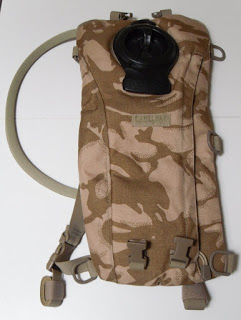
• Water supply: It seems prudent that the mission pack contain a hydration bladder, or can carry or mount some of the water containers from the larger pack.
A supply of water purification tablets should be included.
Many daysacs include a pocket especially designed to carry a hydration bladder.
Some water will be carried on the webbing for when the mission pack is not available.
• Food: Working on the assumption that the mission pack can sustain the soldier for 24 to 48 hours away from their large pack, some food should be carried.
Since the mission pack/small pack will be used within proximity to the enemy, foods carried should be those that can be eaten without heating and foods that may be eaten on the move.
This may warrant the development of a specialized no‑cook “mission bag” ration.
• Warm Gear: Presumably the soldier has dressed for expected conditions before they leave their large pack.
Weather is changeable, however, or the large pack may have been left in haste.
Space for clothing may be limited in the mission pack, but there may be room for a spare bush/Norgee shirt, stowaway shirt, compact fleece or thin jumper.
• Wet gear: the mission pack should include a rain‑jacket and/or rain poncho.
These are carried at or near the top of the pack where they are easily accessible if needed and may dry easily if wet.
If the mission pack is cached or discarded, the rain gear will be one of the items the soldier will want to transfer to their webbing.

• Shelter: The rain poncho may also be used to provide shelter.
Two three‑metre lengths of cord, pegs and shelter pole(s) may be included in the mission pack/small pack for the latter purpose.
Shelter poles will need to be sized to fit within the mission pack.
• Compact survival bag, space blankets. Possibly an all‑weather blanket.
• Toilet roll with 100 ml bottle of hand sanitizer in zip lock waterproof bag.
• Medical Kit: The medical kit will mainly be configured for non‑combat and minor injuries, but may include some trauma items, such as additional CAT and Israeli dressings.
The medical kit should be in a separate pouch, attached to the outside of the mission pack by PALS. It can easily be removed and tossed to a comrade if needed, and is readily available for inspection or replenishment.
• A spare woolly hat and gloves are a prudent addition. Depending on the mission, several types of gloves (for warmth, protection etc.) may be carried.
In wet conditions, the soldier may change into the spare gloves and hat when halted, and attempt to wring water out of their main hat and gloves. When resuming the march, the original items are donned again and the spares returned to the pack.
• Socks: a pair of spare dry socks in a waterproof bag will be a welcome addition to the mission pack and may be used to pad items or fill any small spaces.
• Foot Powder: the mission pack should include a container of foot powder.
Depending on climate, supplies of sun‑cream or insect repellent may be in the mission pack to supplement smaller volumes carried on the soldier’s person.
• Cordage: The pack should include a supply of cordage of various types (e.g. spare bootlaces, bank line, paracord, comms cord, braided fishing line).
A few metres of duct tape may be added.
• Spare Items: These are spares for items carried in the webbing or clothing.
A spare compass, carried in a rigid spectacles case for protection. Spare insect headnet. Spare fire kit. Additional bandanas. Spare shemagh or scarf.
• Goggles, if not in use.
• Stove: Combat operations often precludes cooking. A small emergency stove, with hexamine and/or alcohol gel fuel may be included in the mission pack for purposes of sterilizing water or boiling medical items.
• Cooking Vessel: A metal canteen cup, rectangular mess tin or smaller variety of European mess tin may be utilized as a cooking vessel. The larger vessel may be more suited to sub‑zero conditions.
Pack the interior with other items, but avoid carrying your sooty stove or fuel inside your cooking vessel.
A spork or spoon may be included.
Contrary to tradition, stoves and canteen cups are pack items, not belt kit.
• Brew Kit: Since the mission pack will be used in proximity to the enemy, brewing‑up may not be possible nor advisable.
A small brew kit may be carried, and may be of use in cold conditions and emergencies.
The major part of the soldier’s brew kit should be in an external pocket of the large pack rather than in the belt kit or mission pack.
A tempting idea is for the pack to have two main compartments, one for mission‑specific gear and the other for comfort and sustainment items.
• Mission specific items are likely to be dense, so may be used to compress softer items such as clothing.
• PALS straps will allow the attachment of grenade or magazine pouches to the exterior, providing this does not hamper carrying the mission pack within the larger pack.
• Some of the smaller items should be in smaller compartments so that they are more accessible and may be easily found.
Making the interior lining of the bag a light colour will also assist in finding items.
• The medical kit should be in a detachable external pouch.
• Rain gear should have a compartment that makes it readily accessible and allows it to easily dry.
• The padding on the shoulder straps should be removable, for wear with and without body armour.
• The straps will be daisy‑chained for attachment of camouflage materials such as foliage and textilage.