
Added 4-4-26
Among my various documents I have a kit list for US marines that advises:
“No gear should be carried below the waist. Cartridge belt should be worn high and tight.
Marines should be able to run and execute the obstacle course wearing deuce [LBE/Load Bearing Equipment/webbing] gear”
While this suggestion is logical, what is most striking about it is how widely this advice is ignored.
• Most webbing gear mainly carries its load in pouches on a belt.
Many of these pouches project below the waistline and may interfere with basic actions such as sitting in a transport vehicle or using a roof hatch.
• In many armies, it appears to be common practice to fit as many bulky pouches to the belt as possible. Soldiers look like an MTP Michelin-men or a fat Batman.
• Belts carrying a lot of mass often have to be worn tight. Belts that are cinched tight may hinder ventilation and contribute to fatigue and overheating.
• The configuration of many webbing layouts actually hinders the ability to carry a rucksack.
• Bulky pouches mounted on the chest or the front of the belt may hinder the wearer from crawling or moving close to the ground.
On the modern battlefield, the survival of a soldier or marine will often depend on their ability to utilize microterrain. To avoid enemy fire or observation, a soldier may need to crawl or move close to the ground.
Soldiers may also need to move swiftly across open areas or other obstacles.
Unnecessary mass or bulk that may hinder the fighter crawling or sprinting may get them killed.
• Just because an item can be fitted in webbing does not mean it should be.
In some armies, it is common practice for the webbing to include food, mess-tins, cutlery, stoves, canteen cups, washing and shaving kit, and boot-polish.
I have even seen it recommended that belt web-gear should carry food for two days and the capability to make eight to twelve hot drinks.

A belt kit may weigh as much as 35 lbs. This weight is constantly with the soldier, fatiguing them.
• Body armour and the design of many LBE means that equipment carried in shirt or jacket pockets is not immediately accessible. Chest pockets are covered by armour. Lower jacket pockets are obstructed by belt pouches.
Adding adequate sleeve pockets to field dress is only a partial solution.
Clothing pockets are often not suited to carrying dense objects.
Some of the items carried in pockets or LBE really belong in the mission pack, some in the main rucksack or vehicle.
A couple of hours without tea, or skipping one meal is unlikely to kill you.
Being so weighed down and bulky that you cannot move quickly or crawl when needed, might!
Attaching equipment pouches directly to armour is not a good practice. It makes an already heavy item even heavier.
Many of the drawbacks to this approach are discussed in more detail on another page.
Body armour worn over a coat or combat jacket restricts the ability of air to circulate. This increases the danger of the soldier overheating or becoming chilled from condensed perspiration.
Wearing a smock or similar garment over armour is more practical and improves camouflage.
A combat garment should be roomy for good air circulation.
However, carrying dense items such as ammunition or grenades in the pockets of a loose garment will not be comfortable since they will swing around.
Wearing garments over armour requires some means to carry ammunition and other equipment on the outside.
If a soldier becomes a casualty, a separate webbing system is easily removed to make his ammunition available to his comrades.
A key question arising from above is “how much ammo should the solder carry?”
The 4th Infantry Division at Pleiku, Vietnam in 1967 concluded that no more than 300 rounds per man was needed: “Units should reduce weight loads of individual soldiers by maintaining no more than 300 rounds of ammunition per man. Experience has proven that more than 300 rounds per man is excessive weight and reduces his efficiency in movement over rough terrain.”
From “U.S. Army Uniforms of the Vietnam War” by Shelby Stanton, p.13.
Some of this allocation was probably belt for the platoon’s M60s.
There is little point in carrying more ammunition if the weight makes it more unlikely that you will not survive long enough to use it.
As I have remarked in some of my other articles, finding a solution is often dependent on asking the right question.
In one of the paragraphs above, the key word is most probably “unnecessary”.
What is really necessary and what is not?
What does the soldier actually need to carry, and how?
Many items currently carried in a belt or pockets of a soldier are more comfortably and more effectively carried in a backpack or shoulder bag.
The contents of the webbing/LBE should be equipment that needs to be immediately accessible, with an emphasis on combat and defence.
Less immediate or unit items are carried in bandoliers, shoulder bags, grab‑bags, mission packs and rucksacks.
Webbing will be on the soldier most of the time, while packs may be put down, cached or given to other personnel.
• For the infantry‑role soldier, priority of LBE contents will be for ammunition and other munitions.
Ammunition may be divided between that for personal weapons and that carried for crew-served weapons.
The latter may be more effectively carried in carriers that may be easily dropped near the weapon crews.
• A reasonable quantity of drinking water will be needed.
A hydration pack is often used. When carrying a backpack such hydration packs are often carried in or on the backpack.
An independent supply of water will be needed for situations when a pack must be discarded and there is insufficient time to retrieve the hydration pack.
• Some medical items should be included on the webbing. Priority should be given to Combat Injury-Immediate First Aid Kits (CI-IFAK) designed to deal with gunshot and other major injuries.
The contents of such kits needs to be optimized to ensure that they are effective, versatile and not overloaded with “nice to haves” or “might be useful” items.
More minor injuries are to be dealt with by a medical kit in the soldier’s backpack or a small kit carried as part of the emergency survival items within the trouser pockets.
• Provision to accommodate communication equipment and/or vision gear such as field glasses or night vision equipment may be needed.
• CBRN (aka “NBC”) kit may need to be carried on the soldier’s person in certain operations.
This is best carried in a separate bag that may be included or attached to the webbing or backpack.
• Some provisions may need to be made to accommodate in the LBE various sundry items that would previously have been have been carried in the combat jacket pockets.
These include a compass, combat mirror/heliograph, notebook, whistle, flashlight(s), penknife/pliers/multi‑tool/wire cutters/demolition crimpers, a small weapon-cleaning kit, zip-ties, spork, cam-cream, small bottles of insect repellent and sunblock.
Once a realistic and practical equipment loadout has been identified and enforced, designing a system to comfortably carry it may be attempted.
Generally, we are told to carry heavy masses close to our back, with the hips/pelvis taking most of the load.
Masses are more-effectively carried on the back, so gear that does not need to be immediately available should be carried in a mission pack.
Personal ammunition, and many of the items that should be carried on the webbing are an exception to the above practice.
Many of the items that are likely to be needed at short notice will need to be at the front of the body, where they are readily available.
However, the front of the soldier must not be so obstructed that it interferes with the ability to crawl or operate a weapon.
Any design of webbing/LBE system must take this into account.
The proposed personal ammunition load is based on the “six and six (and four)” concept.
The webbing carries six 30‑round rifle‑magazines, six standard hand‑grenades or their equivalent, and four field dressings (FFD).
The grenade allotment might be considered to be four fragmentation grenades (aka “frags”) (M67/RGD-5-type) and two cylindrical grenades such as smoke.
As a starting point, I will look at the NVA/VC chest rigs used with the AK-series/Type 56 rifles.
Two variations were commonly seen.
Both variants had three large pockets in the centre, each intended to hold two magazines each.
One variant had a smaller pouch on each side of the three magazine pouches.
The other variant had two smaller pouches to each side.
The pouches were mounted on an approximately oval or hexagonal backing that fastened behind the wearer.
A neck loop or shoulder straps helped support the weight.
The seven‑pocket version is possibly better suited to wearers with broader torsos. Some illustrations from the Vietnam war show the outermost pouches riding behind the arms.
It is possible that the five‑pocket models are modified versions of the seven‑pocket.

The Russian Lifchik system is similar, except that the second pattern Lifchik mounts the smaller pouches vertically above each other rather than horizontally. This arrangement may not be suited to wearers with shorter torsos.
While commonly referred to as “chest‑rigs”, some photographs seem to show the Vietnam chest‑rig being worn lower on the body, just above the waist.
This suggests that a similar arrangement that could utilize the load‑bearing potential of the hips/pelvis could be developed.
• Unlike a jerkin, such a “belly‑rig”, “assault apron” or “combat cummerbund” allows more of the upper body and back to be unencumbered to facilitate ventilation and heat loss.
• There is no tight, restrictive belt around the waist.
The main fastening is positioned around the back and therefore out of the way when crawling. The buckle should be offset or fasten at the side so a pack will not press on it.
• The back area is clear for carrying a large rucksack.
Unfortunately, many users in the West regard a chest/belly rig as a way to carry even more gear in addition to their overloaded belt‑kit!
The SPONS/SSO Jaeger system gives us some idea of what the modern belly‑rig might look like. This was one of the few compact systems I have come across that could accommodate the full suggested grenade load. It is possible that this arrangement would not suit wearers with smaller torsos.
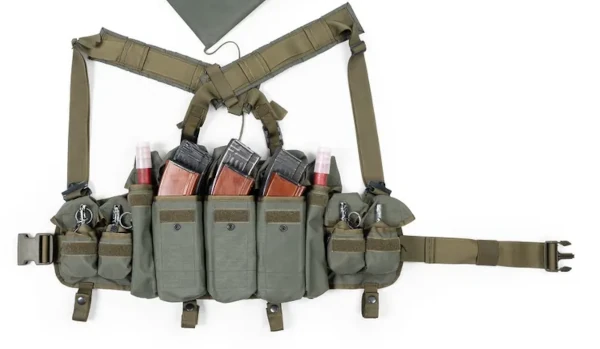
A belly-rig based on the VC/NVA/Lifchik/SSO Jaeger is a step in the right direction, but cannot carry all of the equipment proposed above.
The British 1942 Battle Jerkin included a “bomb pocket” directly under each arm opening around waist level.
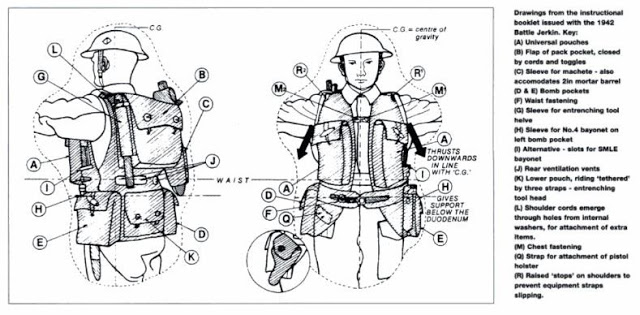
Each bomb pocket could hold two 2 inch mortar bombs, four to six grenades, a water bottle, or two to three slabs of guncotton.
The bomb pockets were over the hips or higher, depending on the fit of the jerkin. A waist‑level strap kept the pockets in position but the weight was borne by the jerkin rather than a waist belt.
A similar feature could be combined with the VC‑type belly rig.
Since a handgun and belt-knife might be worn, the lower pouches should be placed at the 2, 4, 8 and 10 o’clock positions.
Large pouches at the front of the waist area would interfere with crawling.
These lower pouches should be a general purpose or “general utility” design, each capable of holding a one litre water bladder, four magazines in a 2 x 2 configuration, or several grenades.
Adding these four lower pouches greatly increases the utility and potential of the VC‑inspired belly‑rig.
• Chest magazine pouches would be designed to each accommodate two 5.56mm STANAG, two AK-series magazines or two magazines for 7.62x51mm or 6.5mm Creedmoor weapons.
• Position of the chest magazine pouches will depend on comfort and carrying efficiency. They must not inhibit the ability to crawl.
• The flaps of magazine pouches would be detachable so an open‑topped configuration is available.
• Channels sewn behind the chest magazine pouches could be used to carry a supply of zip‑ties.
• The chest magazine pouches and the general utility pouches would have laced sides so they may be adjusted to better hold their contents. These laces would be useful for attaching foliage and textilage for camouflage.
• To the outside of the magazine pouches on the chest/belly, there would be a (elasticated?) pouch suitable for carrying a long, cylindrical object such as a smoke bomb, tear gas grenade or thermite.
This pouch could also carry a fragmentation grenade, compact concussion grenade, stun-grenade or other shorter models of grenade.
The channel in the pouch designed to hold the safety-lever prevents shorter grenades falling to the bottom of the pouch.
The “cylinder” pouch may be used to carry other items, such as a magazine loaded with tracer rounds.
• Outward from the cylinder grenade pouch on each side there would be two smaller “frag” pouches suitable for fragmentation grenades and other smaller grenades such as stun-grenades.
• The South African P83 chest rig has a map/document pocket behind the magazine pouches. 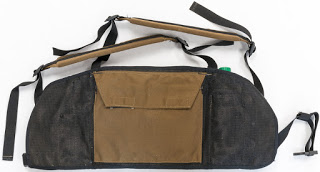
This pocket could be designed to also function as a dump‑pouch to collect empty magazines.
The chest pocket could also be used to carry temporary additions to the belly-rig, such as flares.
A couple of positions for holding pens, pencils, lightsticks or similar items may be incorporated into the document pocket or on the side of some of the longer pouches.
• A water bladder dimensioned to fit in the general utility pouches will be needed.
Air can be squeezed out of water bladders to reduce sloshing noises.
Only one bladder carried needs a drinking tube, any others having a plug/cap for the tube fitting.
General utility pouches would need to include a port compatible with a drinking tube.
• There should be room on the belly‑rig for several first‑field dressings (FFD) and/or a CI-IFAK pouch.
Being soft, some of these may be carried at the back of the rig, where they will not interfere with wearing of packs.
These items may be carried at the rear, since they are more likely to be accessed by someone treating a casualty than the wearer.
The CI-IFAK may be in a pouch that is easily detached when needed.
Field dressings so sized that they may be carried under the flap of a magazine or grenade pouch are possible.
Modern field dressings seem to be larger than older models.
Since the two-round magazine pouch is intended to be low profile and low bulk, using them to also carry FFD may not be practical.
Also, the mass and bulk of FFDs in the flap may hinder quick access to the magazines.
• Somewhere on the front of the webbing should be provision to carry a small flashlight, chemlight, flare or similar object.
Provision to carry a larger flashlight may be needed for some operations.
An elasticated loop provided on the shoulder permits a flashlight to be used “hands‑free”.
Since a wide‑variety of flashlight sizes and models are available, this fitting would be detachable to accommodate a variety of pouches.
• The chest area of a soldier is often shaded. This area needs to be lighter to compensate.
Thus the belly‑rig will be coloured dark yellow/beige, or better still, made in a pattern such as tropentarn or desert DPM. This pattern will be suitable for most environments, with white tape added in snowy conditions.
Three‑dimensional camouflage measures, such as textilage, should be incorporated. There will be provision to add foliage too in verdant conditions.
The belly‑rig so configured will significantly contribute to improving a soldier’s camouflage.
• Straps will be adjustable to allow for different body shapes or varying levels of clothing or armour.
Any shoulder padding may be detached when wearing the rig over armour.
• Suspension system will most probably be a “H” configuration. Loops at the back allow a rolled poncho and/or poncho‑liner to be carried when a pack is not being worn.
• The weak‑side shoulder strap would be a suitable position to mount a “pec-knife” such as a Gerber Strongarm. This would be partially concealed by mounting it behind a pouch for a combat tourniquet.
Tourniquets should be of the type that may alternately be used as a pressure bandage.
A snap‑link would also be added to this position.
The snap‑link may be used for temporarily holding various items. It is also used to collect empty magazines that have been fitted with a pull‑loop on their baseplate.
• Communications systems are likely to get smaller with improved technology, so pouches for these should be detachable to accommodate new equipment and models.
Some designs of load bearing gear mount radios and associated systems on the rear of a rig.
This must be designed so that it does not conflict with the carrying of backpacks.
• While not an item needing immediate access, the belly‑rig would be a logical place to carry a small weapon-cleaning kit. A small “out of the way” pocket might be provided for such an item.
• Carrying very small bottles of sunscreen and/or insect repellent on the belly‑rig might be permissible.
These would be used when larger bottles in a backpack are not available.
• The general utility pouches are detachable.
One general utility pouch could be replaced with an expandable magazine pouch. This pouch would also be designed to act as dump pouch or a helmet carrier, or to hold similar‑sized loads.
• A general utility pouch may be replaced with a quad grenade pouch.
In 1966 Natick developed a grenade pouch intended for use in Vietnam. This should not be confused with an earlier three‑pocket pouch design that was also used in Vietnam.
The upper pocket of the Natick pouch could hold three smoke or fragmentation grenades. The lower pocket held three fragmentation grenades. Each grenade had its own retaining strap and a channel to hold the safety lever.
A four‑grenade version of this pouch would prove useful to modern soldiers.
• The large hip pouches, when used, fit at the sides, between the forward and rear lower pouches.
The hip pouches have a main compartment capacity of approximately two litres.
They should be dimensioned so that each may carry a 200 round belt container for an M249/Minimi.
The hip pouches might be based on the South African Niemoller side pouch design. The top, sides and front of the hip pouch will have pouches for smaller items.
• A machine‑gun belt carrier that may be carried at the hip position and also capable of being mounted directly on to the weapon would be useful. This should be compatible with the M249/Minimi and also new, lighter 7.62mm/6.5mm belt‑feed weapons.
This carrier could also be fitted with the light shoulder straps used with the Dutch bergen side‑pouches.
• 40mm grenade cartridges are probably best carried in a true bandolier belt. This may be worn underneath or across the rifle pouches, and is easily detached and handed off to the team grenadier.
Additional grenade bandoliers are carried in backpacks until needed
• The standard model is intended for infantry riflemen and is likely to be the most common model.
The majority of pouches will be integral (stitched-on).
This will yield considerable weight and cost savings over all‑MOLLE configurations.
• A variant of the rifleman model will have the rearmost frag‑pouches removable. This allows the rear frag‑pouches to be replaced by other designs of pouch, or omitted for wearers with slim bodies or narrow abdomens.
• The “hybrid” model has integral magazine pouches but replaces the grenade pouches with panels for alternative MOLLE pouches.
• The specialist model lacks integral magazine and grenade pouches, but retains the map‑pocket and knife‑fitting.
The area where the magazine and grenade pouches would have been has PALS straps for the placement of MOLLE pouches.
A machine gunner, for example, would have one or two utility pouches on the chest and carry ammunition in the large hip pouches.
A machine gunner’s assistant would wear a rifleman model with large hip pouches carrying belt ammunition.
• The covert model of the belly‑rig is designed to carry up to four standard grenades and pouches for SMG or extended‑capacity pistol magazines.
There is provision to mount a pec‑knife, flashlight and carrier for a suppressor.
The will be a “low‑profile” system that may be worn beneath a light jacket.