Added 5-7-2026
Updated 14-8-2026
The “Tank Design Trilemma”, the ratio between firepower, mobility and protection, is often cited when discussing tanks.
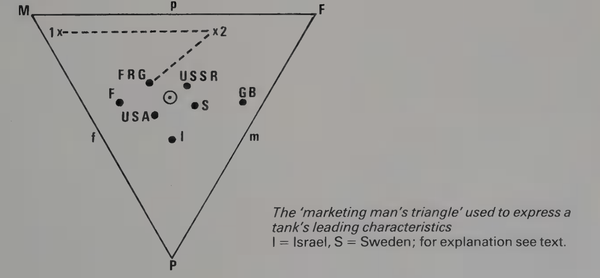
In many of his articles and books, Richard Simpkin used what he called a “marketing man’s triangle” to visualise this relationship.
The triangle is simply a triangle with the corners labelled F, M and P for firepower, mobility and protection. The above example is from “No Speed Please, We're British” in Jane’s 1981-82 Military Annual. It shows Simpkin’s interpretation of the design of early 1980s tanks.
What is less commonly appreciated is that the criteria of firepower, mobility and protection may also be used to study other military systems.
Recently, I came across another historical example of a tank being converted into a more useful tracked utility vehicle.
In this example it was the Stuart M3 light tank. By removing the turret and the marginally effective 37mm gun, a useful reconnaissance vehicle and gun‑tractor was created, also used for duties such as resupply to front‑line units.
It occurred to me that such a vehicle would be towards the mobility-protected side of q generalised AFV FMP triangle, towards the mobility corner. It would be in the company of other LTAPCs such as the M39, M113, and MTBL.
Similarly, the MTAPCs such as the TPC, APFV and medium battle‑taxi, would be towards the protection corner of the same side.
What I have chosen to call the “general AFV FMP triangle” is a little different to the tank FMP triangle used by Simpkin and others.
The general AFV FMP triangle will be used to examine AFVs in general, not just tanks.
MTAPCs and LTAPCs may be considered to be towards either end of the mobility-protection side of the triangle.
Interestingly, both occupy their position due to being tracked.
The LTAPCs owe their mobility to their tracks and relatively low mass.
Tracks allow them to traverse mud, soft sand, snow, rubble and many other terrain types common on the modern battlefield.
Many examples are also amphibious, and have operated in rice paddies or for disaster‑relief in flooded regions.
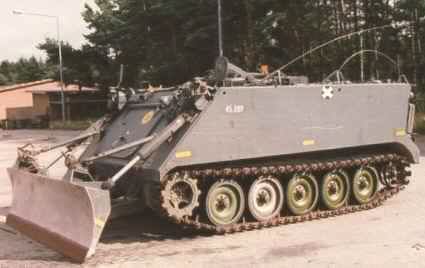
For the MTAPCs, tracks not only contribute to increased mobility, but permit a greater mass of armour and other equipment to be brought into action.
Light Mobile Protected Vehicles also belong at the mobility end of mobility-protection, but for a different reason.
Here mobility represents speed rather than cross‑country versatility. Since such vehicles need to be light, they are further from the protection corner than LTAPCs.
Mobility covers several fields. For a ground vehicle, increased mobility only partially substitutes for protection.
A questionable current trend is to up-gun IFVs with larger cannon, 40mm being the current preference.
The supposed advantage is that this will allow the vehicles to fight other IFVs, and possibly have an effect on more heavily armoured vehicles.
However, TPCs with armour levels exceeding that of some MBTs are already in service.
Modern stand‑off weapons mean that aircraft seldom need to stray within range of any cannon that may practically be mounted on a troop‑carrying vehicle.
These large cannon are too massive to be sufficiently responsive against closer, fast‑moving targets such as small UAVs.
Effectively, the marginally effective 37mm and two-pounder (40mm) guns of World War Two are being reinvented, with an even higher price tag, bloated development cost, and mass penalty.
With the new gun come a mass of associated equipment such as ammunition, sensors, fire‑control, and mounting systems.
If we consider an IFV with such an armament, it must clearly occupy a position on the triangle closer to the firepower corner.
The LTAPCs, LPMVs and MTAPCs all have the transportation of troops or equipment as their primary function.
A vehicle can only carry a finite mass and bulk. If an IFV is up‑gunned, it must either compromise protection or mobility or reduce the mass of personnel and other equipment that may be carried. In, other words, its role as a transport is diminished.
The general AFV FMP triangle illustrates that up‑gunned IFVs are a questionable advance.
Heavily armoured targets are better dealt with using missiles, which many current IFVs already mount. LW30 cannon are a more practical option for IFV gun armament, being light enough to be effective anti-UAV systems.
Bulky, multiple wheeled APCs are very much in vogue at the moment.
The military world is as much subject to fashions as are other fields, and like other fashions, these are not necessarily practical nor logical.
The reasons for the interest in multi-wheeled APC (MW‑APC) have been covered elsewhere. Suffice to say, their adoption has profited some people no longer in uniform much more than those still wearing theirs.
Once, the use of wheeled APCs like Saracen, Saxon, Humber Pig or BTR-40/60/70/80 could at least be justified in terms of economy. This is no longer the case for the modern examples. A Stryker Infantry Carrier costs $4 million to $5 million.
Vehicles such as the Stryker are large and bulky. Difficult to camouflage and large targets, they are easily engaged by even unguided weapons such as the ubiquitous RPG.
The considerable mass of the Stryker means there is little potential for practical improvements in armour or armament. The Stryker is to be upgraded to mount a LW30 cannon, but how useful that will be on a vehicle unlikely to survive long in combat is open to question.
While manufactures will vaguely state that cross-country performance of their MW‑APCs is “good”, bulk, mass and high ground pressure make this claim seem highly unlikely on most types of terrain.
For example, the Stryker needs a special dispensation to drive on US civilian highways. The Stryker is too much of a load for the same highways that routinely carry eighteen‑wheeler trucks. The US Army callously exploited the aftermath of 9-11 to guilt‑trip state authorities to issue such dispensations.
The multi-wheeled APC hovers rather awkwardly over the centre of the FMP triangle.
This position should indicate an even balance of firepower, mobility and protection, but the MW‑APC achieves this by being equally deficient in all three.
Rather than being a “Jack of All Trades” it is in reality “Master of None”.
The firepower corner of the general AFV FMP triangle is a place for dedicated combat vehicles rather than transports. Shooters rather than carriers.
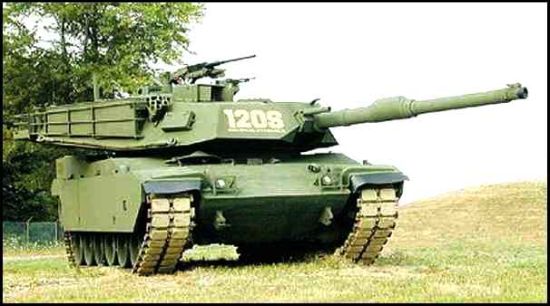
The traditional main battle tank (MBT) appears towards the firepower-protection side of the general AFV FPM triangle.
Considerable historical evidence, and simple logic, suggest that a vehicle with a heavy gun armament requires sufficient protection to survive long enough to put such an armament to good use.
This lesson, however, seems hard for some military minds to retain.
It may be argued that some MBTs have strayed a little too far from the mobility corner. A tank (or any other AFV) that cannot reach the battle in time is of no use.
Many MBTs are too heavy for bridges designed for heavy commercial and agricultural vehicles. (“Trafficability” was a theme Simpkin often addressed)
With mass comes increased demand on logistical and maintenance resources.
Aircraft that can transport MBTs by air are relatively rare, even in US service.
To make tanks more strategically and operationally mobile, a shift in protection, firepower or both is needed.
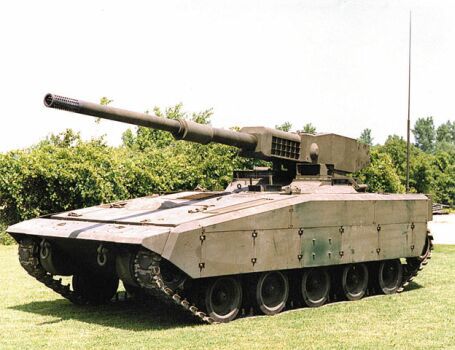
Since a tank needs to survive long enough to put its armament to good use, my preference to reform the tank’s armament.
The need for the 130mm and 140mm tank guns under development is questionable.
A good argument may be made that the 120mm/125mm weapons currently used are more gun than is needed for many targets. The large rounds of such weapons limit the ammunition capacity of a platform and complicate ammunition handling.
If a tank is provided with an adequate quantity of anti‑tank missiles, its gun armament is relieved of the role of primary anti‑tank system.
A lighter gun, more suited to the non‑tank targets more likely to be engaged in a fire‑support role may be fitted.
The mass of associated structure such as trunnions will also be reduced.
Ammunition has less bulk and mass, allowing a more useful quantity and variety to be carried.
On my Thunderback page I give an example of such a “tank” using a 76mm gun resembling that used on the Rooikat armoured car. A 57mm‑armed “flak tank/C‑RAM” intended for both ground and ground to air targets is also described.
Better armoured air‑defence/C‑RAM vehicles that can support more conventional tanks have obvious value for future conflicts.
The third side of the general AFV FMP triangle is firepower-mobility.
In the firepower corner is an interesting assortment of examples.
◦ This includes unarmoured and lightly armoured anti-tank vehicles mounting missiles, recoilless rifles or conventional anti‑tank guns.
In the dark days of the Cold War and imminent Soviet invasion of West Germany, such platforms were perhaps understandable.
Knocking out Warsaw Pact tanks was a priority over crew survival.
That such “Kleenex commandos” and “Chariots for a Purple Heart” are still offered and fielded is perhaps not so acceptable.
Also in this corner we have armoured cars, light tanks and the American interpretation of “tank destroyer”.
◦ Armoured cars are most often associated with reconnaissance. Elsewhere, I have discussed how it may have been something of a historical accident how reconnaissance units came to be equipped with armoured cars.
A good argument may be made that vehicles such as LTAPCs or LPMVs are more suitable for reconnaissance, being better suited to the transport and deployment of dismounted scouts or UAV control teams.
Armoured cars in reconnaissance forces were often used in a fire‑support role, actual scouting being conducted by other vehicles.
Armoured cars have often served in counter‑insurgency, internal security, escort and raiding roles. Tasks for which more mainstream AFVs have often been ill suited for.
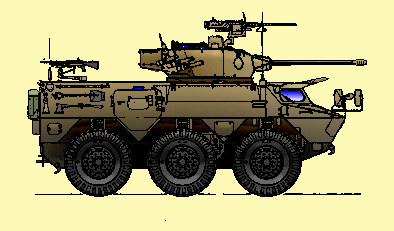
During the Russian Civil War, armoured cars would attack horsed cavalry by driving into the formation and laying down fire to all sides. This is why Russian designs of this era mounted a pair of machine gun turrets.
The successful use of armoured cars in this and many other roles depended upon the enemy lacking any weapon capable of penetrating the armoured car’s thin armour.
The M8 Greyhound is another design that lost its turret and 37mm gun to create a useful utility vehicle (M20), although this was a factory‑made variant rather than a field improvisation as with the M3 Stuart.
The M20 and reconnaissance versions of the M39 included a bazooka in the vehicle's standard equipment.
◦ Most air‑defence vehicles are firepower‑mobility platforms. Even when based on heavier vehicles, they generally have low armour levels and omit other defensive systems.
Typically armed with multiple automatic weapons, such vehicles are often used against ground targets. Increased defences would make them more effective for this role.
◦ Arguably, the combat history of light tanks is somewhat patchy.
Sometimes they have been designated as reconnaissance vehicles, but in practice served as fire‑support for other reconnaissance vehicles.
Sometimes, light tanks served in armoured car roles in terrain that would have challenged wheeled vehicles.
The historical accounts of successful use of light tanks as more general combat platforms often come with the caveat that conditions were unusual or that the enemy was poorly provided with anti‑tank systems.
In my mind, at least, there are some doubts as to the practicallity of using light tanks in future conflicts. Many of the “tracked armoured car” roles might be better met by variants of tracked IFVs.
◦ The World War Two US tank destroyer doctrine was based on a flawed understanding of how tanks would be used in combat.
The US Army intended to use its tanks as independent units, like horse-mounted cavalry had operated. Thus its tank destroyer forces were designed to be highly mobile and lightly armoured to counter such forces.
In practice, Germany used its tanks as part of combined arms forces. Lightly armoured and unarmoured American tank destroyers found themselves engaged by artillery, the automatic cannon of flak and reconnaissance forces and infantry with anti‑tank weapons and training.
As an aside, the German interpretation of what a tank destroyer should be sits on the firepower-protection side of the triangle. German tank destroyers were well armoured so they could survive long enough to use their armament to good effect.
During the Cold War, several designs of armoured cars mounting large calibre tank guns such as the Eland saw combat.
Such wheeled tank destroyers could not fully substitute for conventional tanks. Survival often depended on which vehicle landed the first effective hit. Tanks often had superior armour, sensors, armament and fire control.
Despite its chequered history, the idea of mounting a big gun on a lightly armoured platform continues to persist.
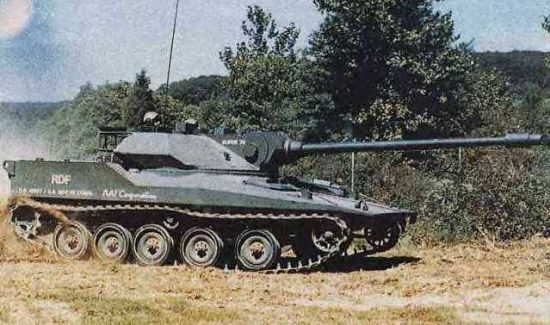
Every decade or so, the US Army will toy with the idea of a more air-deployable fire-support vehicle, although it very pointedly seems to go to great lenghts to avoid using the term “light tank”.
The M1128 Stryker Mobile Gun System seems to fail the necessary requirements on every count, including being easily air-transportable.
Advocates of lightly armoured gun systems will point to successful historical examples such as the M3 GMC, Sd.Kfz 234/3 and 234/4 or Sd.Kfz. 251/9.
It is dangerous to draw lessons from history without full context.
These vehicles usually operated as a component of combined arms forces, well supported by infantry and other weapons.
At the start of the Second World War, an infantry battalion’s anti‑tank capability was limited to a small number of anti‑tank guns of 320 to 450 kg mass or more.
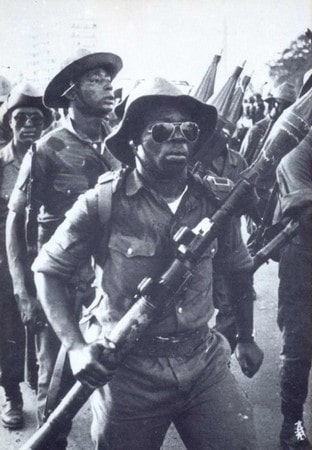
After 1942, weapons such as the bazooka, panzerfaust and PIAT gave small teams of infantry a potent capability against tanks and other targets.
Modern lightly armoured vehicles are highly likely to encounter RPGs and more potent weapons.
Looking at modern and proposed combat vehicles within the context of the general AFV FMP triangle has proved illuminating.
Some of the claimed “improvements” in military capability currently being promoted may be just the opposite.
Mobility and protection are the areas where the most improvement is needed.
• Tanks, or their equivalent, need to become more strategically and operationally mobile, but not to the extent that protection and survivability are significantly compromised.
• The procurement of expensive, oversized wheeled APCs needs to be halted.
If there is a genuine need for wheeled personnel carriers, simpler, more economical vehicles must be introduced.
• For transport vehicles, mobility and protection must both be priorities.
The vulnerability of vehicles to weapons such as RPGs, loitering munitions and guided missiles remains a challenge.
C-RAM/Flak‑tank vehicles may have an increased role in providing in depth defence to ground forces and operationally important areas.
• SLMs and other new technologies may require certain long established assumptions and tactics to be challenged.
The use of tanks and the current models of APC may become less common in direct combat.
Many vehicle‑mounted weapons available now may be used in a non-line of sight (NLOS) mode, reducing the vehicle's exposure to direct fire.
Shoulder-Launched Munitions (SLM) and UAV systems give an individual or small dismounted team the destructive potential of an artillery shell.
Stealthy, dismounted combat personnel and UAVs can attack targets directly or locate targets for nearby ground vehicles or aircraft.
Future war‑fighters might do well to remember the maxim once taught to carrier platoons: “When in doubt, dismount!”
If an enemy is known or suspected to be within a few hundred metres, dismounting is often prudent.
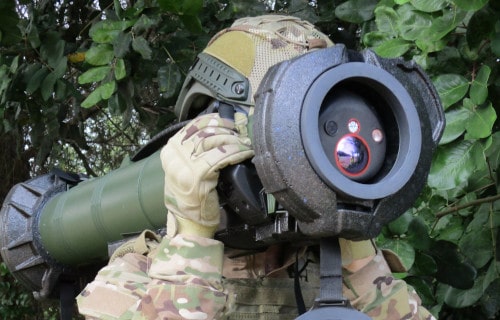
A pickup truck or APC with a dozen or so SLMs or portable missiles in the back and a pair of dismount weapon teams may prove a more useful weapon system than a more complicated and greatly more expensive tank.
During a combat operation, the main purpose of the transport vehicle becomes as a source of ammunition for the dismounted teams.
Such a role favours a small vehicle that is easily concealed from direct attacks.
Vehicle armament, other than UAV defence, becomes a lower priority. Such a transport will most likely mount machine guns and either an automated 40mm AGL or LW30. For vehicle self-defence, infantry anti-tank weapons and patrol mortars may be fired from the vehicle roof‑hatch or flatbed, or by dismounted teams.
• Transporting combat personnel and weapons into the area of operations may in future involve means other than conventional military vehicles.
Recent conflicts have seen the use of easily replaceable transportation such as electric scooters and pickup trucks.
Mimesis is itself a form of protection, making civilian appearing trucks and vans preferable to overtly military vehicles.
The requirements of a vehicle to be used within the area of operations and for that to transport forces and materials to the AOO are not necessarily the same.
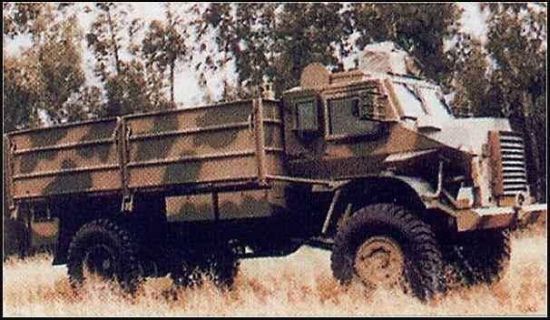
Where there is a probability attack in transit, a pool of “commuter” large MRAPs, tasked specifically with transit to and from AOO would be valuable.
Such a unit would need to include mine countermeasures systems and some form of “escort” C‑RAM/Air Defence capable of dealing with ground and air attacks to a convoy.
• If it is not practical to protect a vehicle of a given size or weight from RPG rounds and heavier weapons, it may be more efficient to limit protection to just SAF‑HE/F levels.
Strategies to minimise damage, facilitate repairs and maximise chances of crew and passenger survival need to be emphasised.
• If an APC like the Stryker is unlikely to last more than a few minutes in intense combat, is it wise to provide that vehicle with NBC systems and all the other equipment it is unlikely to survive long enough for its occupants to benefit from?
Is a thermal imager for the driving position needed if the driver has also been issued with night vision goggles?
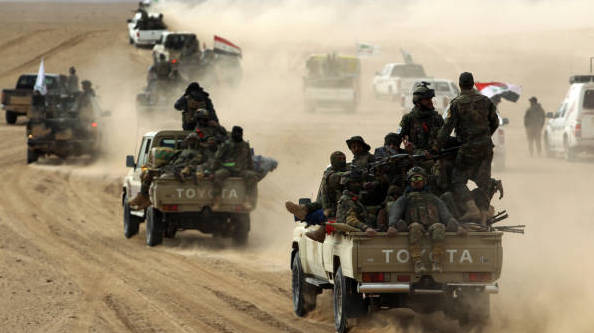
For the cost of a single fully equipped APC ($4 million to $5 million in the case of the Stryker), an infantry unit might have a score or more of pickup trucks.
Both the Stryker and a pickup are effectively out of a fight if they take an RPG hit. If a squad had been spread over several pickups, there will be space for survivors from the hit vehicle. Troops are possibly more likely to dismount and disperse from a pickup if enemy presence is suspected.
Many civilian OTS vehicles are more capable than their considerably more expensive, soft‑skin military equivalents. A new HMMWV costs from $220,000 to over $500,000, while a new Toyota Hilux costs between $22,000 and $40,000.
• Ralph Zumbro was fond of the idea that if infantry had a sufficient level of body armour, their vehicle could be more lightly protected, concentrating protection on the vital components, which included the occupants.
The same logic can be extended further.
If sensor and communications equipment is designed for both dismounted and vehicle use, it may be easily transferred between vehicles should a vehicle become disabled.
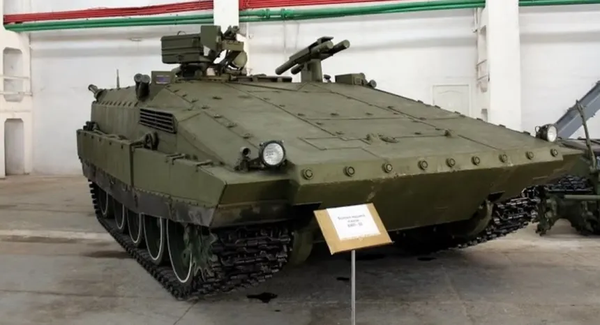
To survive on modern and future battlefields, the APC/IFV will need to become better protected.
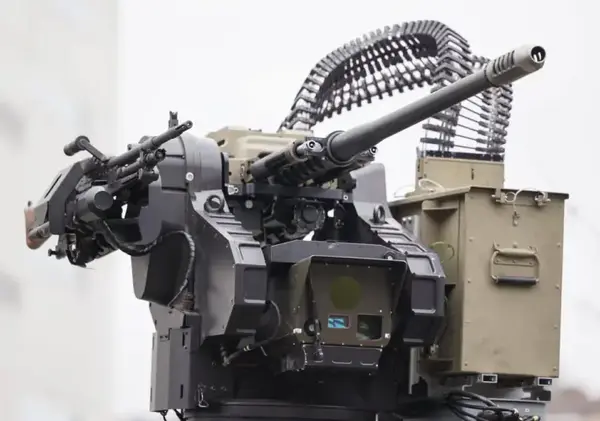
An automated 40mm automatic grenade launcher or LW30 cannon, loaded with multi-function air-burst ammunition so that it may engage UAVs and other targets, seems the optimal choice for armament.
The capability to deliver smokescreens to support dismounted infantry several hundred metres away would also prove useful.
In combat, the APC/IFV’s main function is as a mobile resupply point for dismounted troops.
A compact vehicle that is more easily concealed is desirable, if this can be achieved without compromising on needed capacity and protection.
The increased mobility of tracks allow a wider choice of concealment locations and heavier armour and payload.
The escalating cost of military equipment makes it unlikely that most armies will be able to provide every infantry squad with an APC/IFV.
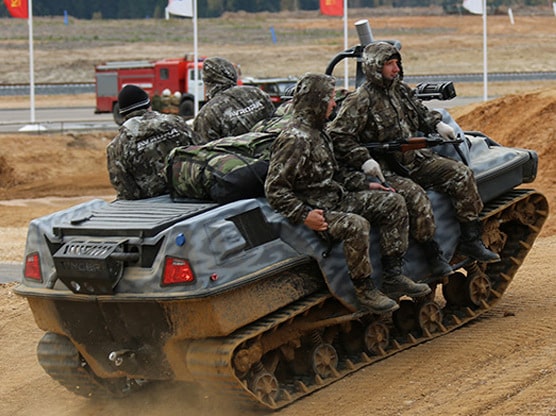
Even if this were not the case, the wisdom of providing models that may have a very short combat lifespan is questionable.
Platforms other than traditional APC/IFVs may be used as a mobile resupply point.
For example, a unit with “use ’em till you lose ’em” trucks might also be provided with one or two tracked equivalent of pickups.
The tracked pickup would be basic, simplified tracked vehicles, perhaps along the lines of a tailgated CT20 Oxford carrier.
It would be a low, compact and low-cost vehicle, easily maintained and versatile.
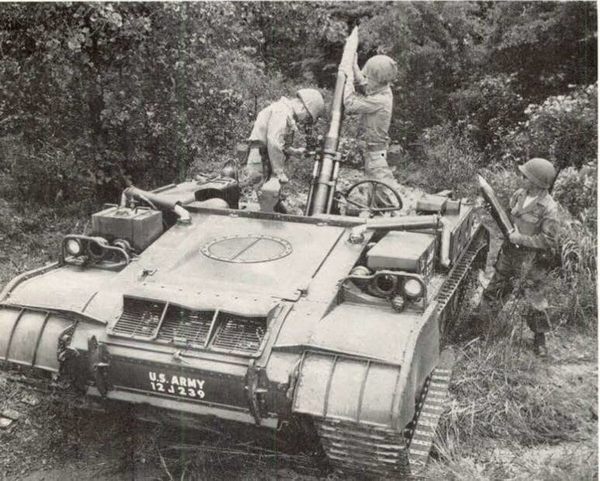
While not intended for direct combat, such a vehicle could be used in the role of carrying a mortar system, multiple rocket system or NLOS missiles.
If such weapon systems were designed around a pallet, pickup trucks or other flatbed vehicles might also be used to deploy them.
It would be very useful if the pickup track was light enough to be helicopter‑transportable.