The euphemistically named Archaeology Field Investigation Detachment (AFID) is the military support unit for the scientists of the Temporal Anomaly Research Group. Soldiers joked AFID stood for “Automatic Fire Irritates Dinosaurs”.
While the soldiers assigned to protect the Temporal Anomaly Research Group were often referred to as special forces it is important to understand that they are more accurately thought of as being a special purpose unit. The majority of volunteers to this unit did not come from a special forces background and many were not even from infantry units. The early AFID soldiers had access to special equipment but often did not have sufficient experience to guide their selection, so their performance in early missions was sometimes less than ideal.
This tendency can be seen in the uniforms selected for the unit. Soldiers wore black fatigues with black baseball caps. While these looked the part it was soon found that black uniforms were difficult to keep clean and uncomfortable in sunny weather. The first reform of AFID saw the introduction of the famous tiger wasp uniform. This was a “tiger-stripe” pattern based on the natural warning colours of black, red, yellow and white. Understandably the performance of tiger wasp varied. Some creatures could not even see the colours while others would attack any perceived threat, regardless of its colouration. Reports indicate some creatures do seem to have hesitated in attacking AFID troopers in tiger wasp. Tiger wasp also proved popular since it was unique to AFID, promoting unit morale and making its members easy to identify, which was useful at times. Black uniforms are still worn by the AFID when out of the field as fatigues, barrack wear and for guard duty.
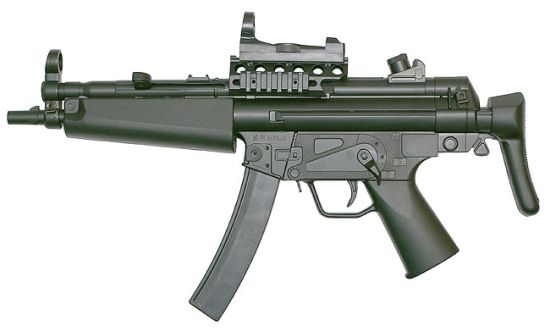
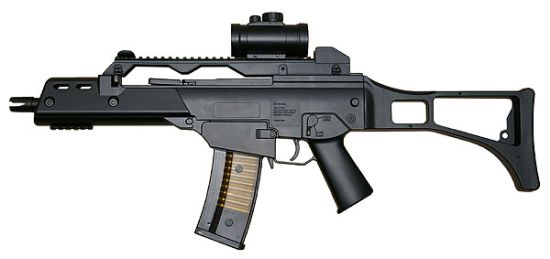
When what was to become AFID was first deployed soldiers usually carried Hecker and Koch MP5s or G36Cs. While both weapons are popular with special forces personnel it soon became apparent that both were inadequate for dealing with threats that were often large, thick-skinned and tenacious. Despite this it took some time before AFID began to field suitable weaponry.
Listed below are the more common weapons used by AFID. AFID and the scientists they support have often had to use less conventional weapons. Various tranquilliser guns are used. Even less conventional equipment has included harpoon guns, crossbows, leaf-blowers and a samurai sword.
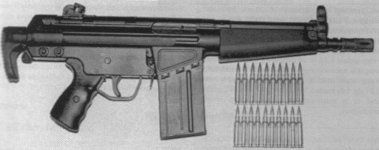
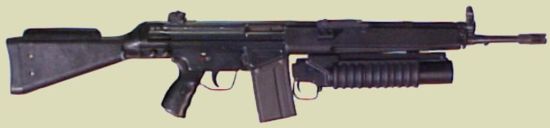
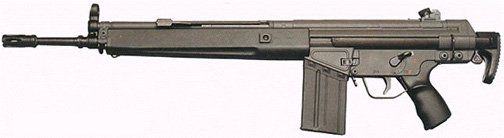
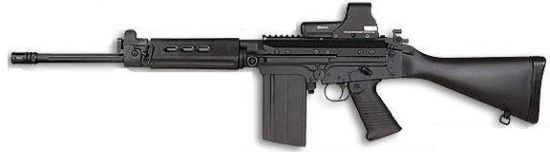
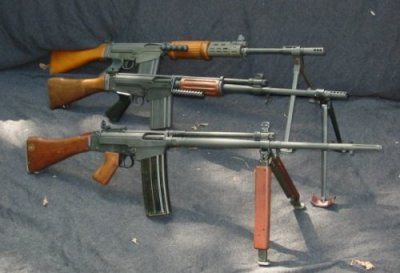
| 7.62mm Battle Rifles Several models of semi-automatic or selective fire rifles in 7.62x51mm calibre are used by AFID. One of the first designs to be acquired was the German Hecker and Koch G3, which was already produced under licence in Nottingham. This is a roller-delayed blowback weapon with a 17.7” barrel. The purchase of these weapons was intended as a temporary measure until sufficient numbers of other weapons could be acquired, but some are still used. Many of the weapons used by AFID have been fitted with a telescopic stock to make them the G3A4 configuration. Such weapons weigh around 10 lbs and are 33” long with the stock retracted.Given how well it had served the British Army in the past, the first choice of AFID was the Fabrique Nationale FAL, known in British Service as the L1A1 SLR. Ironically, since this weapon is no longer in service with the British army many of the weapons used by AFID had to be brought from licensed American Manufacturers. Hence many of the FALs used by AFID are new weapons such as the SA-58 Tactical from DSArms. An advantage of this is that these weapons have rail interface systems allowing the mounting of modern sighting systems, tactical lights and other accessories.![]() Many of the FALs used by AFID are of a heavy-barrel configuration and selective fire. This gives a weapon that can produce reasonably accurate automatic fire while still practical to fire from the shoulder. The use of a heavy barrel raises the weight of the weapon from 9-10 lbs to around 13 lbs, depending on if a bipod or other accessories are fitted. Some of the first FAL-HBs tried by AFID were Canadian C2A1s and Australian L2A1s which can be recognized by a bipod that also serves as a forend when folded. Some of the newer FAL-HBs have a copy of this bipod, while some have more conventional bipods and other users don't fit a bipod at all, since AFID troopers often have to fire on the move. A number of FALs with standard-weight 16.25” barrels are also used, often fitted with M203s. While the standard magazine for an SLR is 20 rounds, 30 round magazines may also be seen. These were produced for the L2A1 and C2A1 and the L4 Bren gun. Bren magazines need their springs strengthened since they were originally designed to feed downwards with the assistance of gravity. A problem with these 30 round magazines is they are too long to allow the use of many designs of bipod, but this is not a problem for weapons not used in the prone LMG role. |
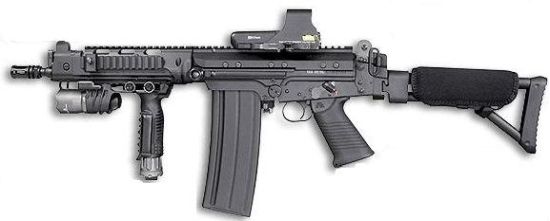
| Another unusual variety of SLR seen used by some AFID personnel is the DSArms SA-58 OSW, a sub-machine gun sized version of the SLR with a folding stock and 11-13” barrel. These are favoured by some AFID Assault/Scout units and some officers. AFID have also acquired a small number of FR Ordnance/ Imperial Defence Services 7.62mm MC51, a submachine gun sized variant of the G3 with a 9.1” barrel. These were probably acquired from other special forces units who have discarded them in favour of other weapons. Although short-barrelled the use of the powerful 7.62x51mm round in the OSW and MC51 gives sufficient power to penetrate 13mm of steel with armour-piercing bullets. |
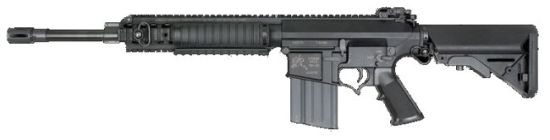
| AFID is also known to have small numbers of 7.62x51mm AR-10Bs and SR-25s. Many modern special forces soldiers are more familiar with the 5.56mm M16 than the SLR so the AR-10B and SR-25 are used to familiarize AFID soldiers with shooting the calibre before they learn the new controls of the G3 and SA-58. Some troops do carry SR-25s or AR-10Bs on missions, with the 16” barrelled models being most common. | ![]() |
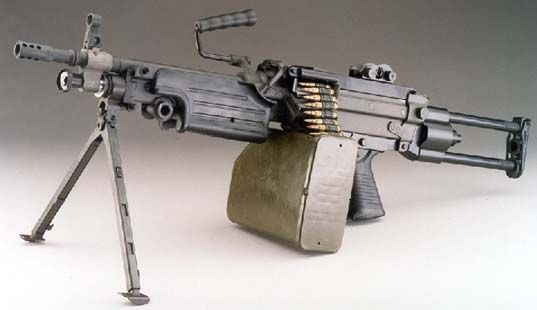
Minimi-Para L110A1/M249The second most common weapon used by AFID is the Minimi-Para L110A1 machine gun. This is a relatively light belt-fed weapon firing the 5.56x45mm round. AFID use the “Para” model, which has a folding stock, 13.75” barrel and weights around 15.5 lbs. While the barrel length is a little short to get optimum performance from the round this is somewhat compensated by the high volume of accurate fire the weapon can produce. AFID units field large numbers of these weapons. An AFID unit may have 30-50% of its force carrying L110A1s, with the majority of the rest carrying 7.62mm battle rifles. |
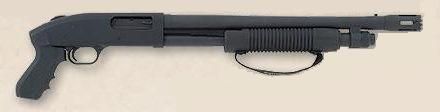
Mossberg Cruiser Shotgun Shotguns are regarded as a secondary weapon by AFID, mainly used for breaching locked doors. However, at times they have proved useful against smaller, fast-moving targets. UKSF are known to have used L32A1 Browning Auto-5s, Remington 870 Wingmasters and L128A1 Benelli M4s. The weapon most commonly seen in AFID hands is the Mossberg 590 in “cruiser” configuration. |
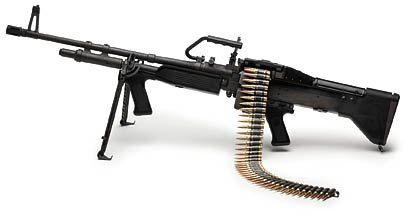
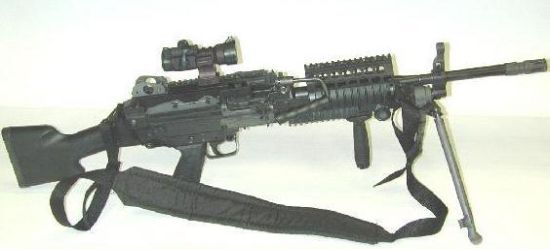
M60E3 and Mk.48 mod. 0
|
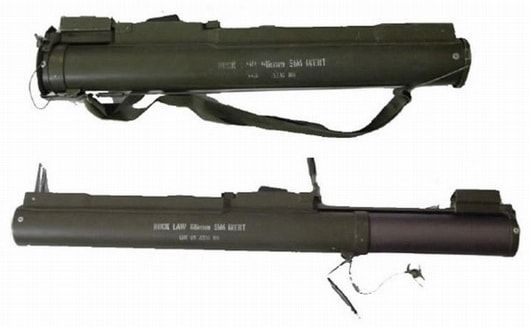
![]() | For situations where small arms do not offer enough power AFID teams carry the 66mm M72 LAW disposable anti-tank launcher, which weighs less than 6lb. In addition to the hollow charge warhead LAW they also use the L72A9 Light Anti-Structures Missile variant. The LASM is modified for structure demolition purposes, with a warhead containing about 1 kg of an enhanced blast explosive, whereas the LAW contains about a third of a kilo shaped charge. |
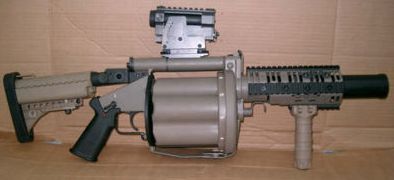
| Milkor M32 Grenade Launcher AFID has a number of 40mm six-shot M32 grenade launchers. HEDP rounds have proved effective against a variety of targets. The main criticism of the weapon is the long arming distance of the grenades. Although the grenades have a casualty radius of around 5 metres the rounds take 14-27 metres to arm, limiting their use during shorter range engagements. The grenadier also carries a variety of other grenade types including smoke, illumination and irritant gas. Many AFID M32 grenadiers prefer to carry smaller weapons such as a MP5 for self‑defence rather than a rifle. | ![]() |
| M203-PI Grenade Launcher |
This model can be fitted to weapons other than the M16, allowing them to be mounted on G3s, FALs, AR-10Bs or Stoner SR-25s. The addition of the grenade launcher adds 3 lbs to the rifles weight. To save weight the M203 is mounted on non-heavy-barrelled versions of battle rifles, usually models with shorter, lighter barrels. The G3 is often used in this role and the grenadier carrying the weapon is often also issued with R1M1 grenades. |
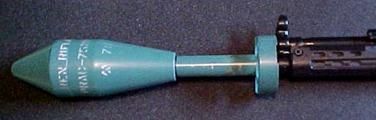
Denel R1M1 Rifle Grenade The R1M1 is a large 75mm muzzle-launched rifle grenade. It is used in situations where the backblast of the M72 means it cannot be easily used.The R1M1 can be fired from the SLR but requires the gas regulator to be closed first. It can be fired more readily from the SR-25 or AR-10B since these have a closed gas system with no regulator that needs to be closed off. The R1M1 can also be easily used by the G3 since it uses a roller-delayed blowback rather than a gas system |
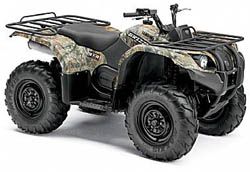
![]() | In many situations small arms, grenades and LAWs are not sufficient and AFID has learnt to keep heavier weapons available. Since temporal anomalies seem to often occur inside large buildings or in areas difficult for conventional vehicles to reach AFID has a number of Yamaha Grizzly 450 quad bikes that it uses to move its heavy machine guns and other weapons about. A number of these quad bikes were acquired by the British Army during the Iraq War. After the war they were decommissioned since it was felt their petrol engines were a logistical complication in an army that mainly ran on diesel. The majority were sold off to civilians but a small number were taken by AFID, who were not bothered by the petrol engine and if anything considered this an advantage for vehicles that operated on the British mainland. The quad bikes are carried to the area of operations inside transit vans which also transport the heavy weaponry and other equipment. |
Heavy weapons used by AFID include:
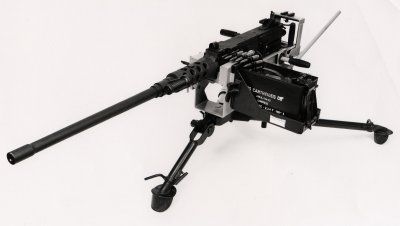
![]() | The L2A1 Heavy Machine Gun This is the British designation for the M2 .50 calibre HMG, although generally it just gets called a “fifty” or a “Browning”. It is hard hitting and has sufficient range and rate of fire to be effective against distant flying creatures as well as large and/or well armoured ground creatures. .50 calibre machine guns are usually moved around by quad bikes. Some quads include pintle mounts that allow the HMG to be fired from the vehicle rather than needing to set up a tripod on the ground. |
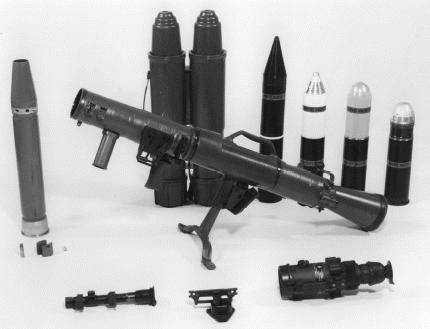
![]() | L14A1 84mm “Carl Gustav” Recoilless Rifle This tried and proven weapon system provides a longer-ranged supplement to the M72 LAW. In addition to its anti-tank rounds the “Charlie G” can be loaded with a variety of other ammunition types, including high explosive, flechette, smoke and illumination rounds, which has proved useful at times. |
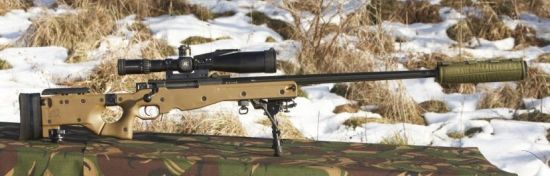
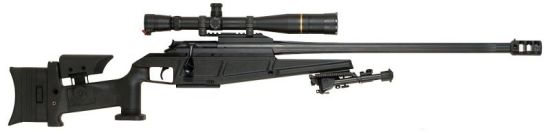
![]() ![]() | The L115A3 Sniper Rifle AFIDs equipment includes a number of high-powered rifles for situations when precision rather than volume of fire is needed. Many of these guns are commercial models but the inventory is known to include several military .338 L115A3 sniper rifles which offer a good balance of power, accuracy and range. At least one Blaser R93 LRS2 Sniper Rifle (lower) is also known to be in the inventory. Whether this is 7.62x51mm calibre or .300 Win Mag is not known. |
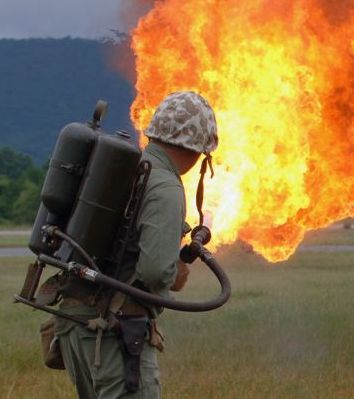
![]() | Hydroar LC T1 M1 Flame-Thrower While large animals are a major worry to AFID some of the threats that have emerged from anomalies have been smaller but just as troublesome. Flamethrowers proved to be a useful system against creatures not easily dealt with by small arms or rockets. A number of home-made flamethrowers were produced in REME workshops for AFID. Eventually systems such as the Brazilian-made Hydroar flamethrower were acquired. |