FIBER OPTIC GUIDED MISSILES (EFOGM)
The EFOGM is the most revolutionary weapon since the arrival of the attack helicopter 30 years ago. Unfortunately, few US military officers are aware of its existence. The EFOGM (below) is basically a long-range TOW Anti-Tank Guided Missile perfected by the US Army in the 1990s. It flies a high trajectory guided by a TV camera in the nose of the missile which remains connected to the launcher by spooling out a fiber optic cable thinner than a fishing line. A soldier watching a video screen guides the missile with a joystick and crashes it into the target. It can strike armored vehicles, helicopters, or any tactical target within 10 miles. More details are here: EFOGM
A tank battalion can be annihilated by an EFOGM battery several miles away, especially since an EFOGM strikes downward and into a tanks' light overhead armor. Even attack helicopters will stay clear of areas where EFOGMs are reported, since EFOGMs can be used against them. Since an EFOG-Missile does not fly a ballistic path, it's launch location cannot be determined by counterbattery radar. EFOGMs do not need to "shoot and move" they can "shoot and shoot." As a result, EFOGMs teamed with counterbattery radar can devastate gun batteries and mortar positions from over 10 miles away.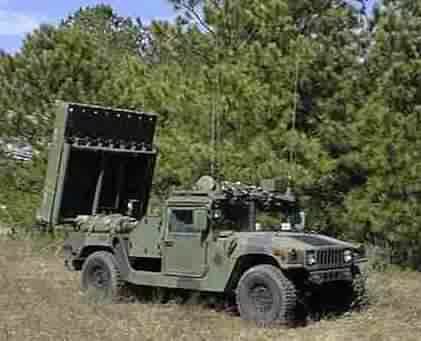
EFOGMs may be fired into an area simply so that its TV camera can verify an enemy presence for gun batteries. EFOGMs can also be fired from HMMWVs in landing craft cruising a few miles offshore. The Navy, which has long range wire-guided torpedoes in service, can also fire these wire-guided missiles from Seahawk helicopters, frigates, or patrol boats to hit small boats and targets ashore.
The EFOGM is an ideal weapon for light forces. Two can fit inside a C-130 and a C-17 can carry eight. An EFOGM system mounted aboard a HMMWV requires only 40% of the manpower, 10% of the ammunition, and 25% of the embark space of a 16,800 pound M198 155mm howitzer towed by a 22,000 pound truck. Here are comments by retired Army officer Mark Gallmeier's about the history of the FOGM, which is now called the Enhanced FOGM, or EFOGM: